News


New laws to improve the way super is divided in divorce
A new law will level up the playing field for divorcing couples to ensure both partners have fair and equitable access to superannuation, particularly during acrimonious family court proceedings.

Important news on the compulsory director identification number (DIN)
This is important information for anyone who is a director of a company, registered foreign company, registered Australian body or Aboriginal and Torres Strait Islander corporation.

Xero Price Increase
Changes to Xero's business and partner edition pricing will commence from 23 September 2021. The cost of Xero Standard and Premium plans will increase in Australia (the price for Starter will remain the same).

Christmas and the Taxman
When do employee gifts and celebrations attract fringe benefits tax (FBT)? And when are they exempt?
Christmas is traditionally a time of giving – including employers showing gratitude towards staff for a job well done. However, Christmas
parties and gifts can attract the attention of the Taxman.

SuperStream deadline fast approaching
SMSF trustees must get ready to process rollovers via SuperStream by 1 October 2021. This means trustees will no longer able to send and receive paper rollover benefit statements and cheques between superannuation funds.

Home as a place of business during COVID: CGT implications
The COVID-19 pandemic has resulted in more employees working from home than ever before. This, in turn, has resulted in such people being able to claim a range of deductions for various “running expenses” associated with working from home.

Compensation payments: Avoiding contribution issues
Superannuation fund trustees who receive compensation from financial institutions and insurance providers must consider how receipt of these payments may impact a member’s contribution caps.

COVID-19 JobSaver & Mirco-Business Grant Update
All businesses receiving the JobSaver and Micro-Grants must be re-tested on their eligibility to receive future payments.

Stapling super: Reducing multiple accounts for employees
New legislation will ensure that when an employee moves jobs, the super fund they used with their former employer will be ‘stapled’ and will automatically follow them.

Trust distributions to non‑residents
When an Australian trust makes a distribution to a non-resident beneficiary, it is often the case that the Australian trust is required to pay tax on the distribution.

Buying a new home before selling the old one: The ins and outs
Sometimes an individual or couple decide to buy a new home before selling their existing one. In such cases, a concession exists that allows for both houses to be treated as a main residence for up to six months – but only if certain conditions are met.

Claiming GST credits for employee reimbursements
If you are an employer registered for goods and services tax (GST), you may be entitled to claim GST credits for payments you make to reimburse employees (including company directors) or partners in a partnership for certain work-related expenses.

SMSFs & property development Emerging risks
There has been an increase in the number of SMSFs entering into arrangements where real property is purchased and developed to subsequently be sold or rented out. Such investments can help the fund build up its wealth more quickly than other forms, and from a tax standpoint, any rent or eventual capital gain may enjoy concessional tax treatment.

How to treat work-related travel and living away from home costs
The ATO has released new guidance to help clarify the tax treatment of costs and allowances incurred when an employee travels – or spends time living away from home – for work.
NSW COVID support for businesses and households
Help available for NSW businesses and households impacted by COVID-19 and recent lockdowns.
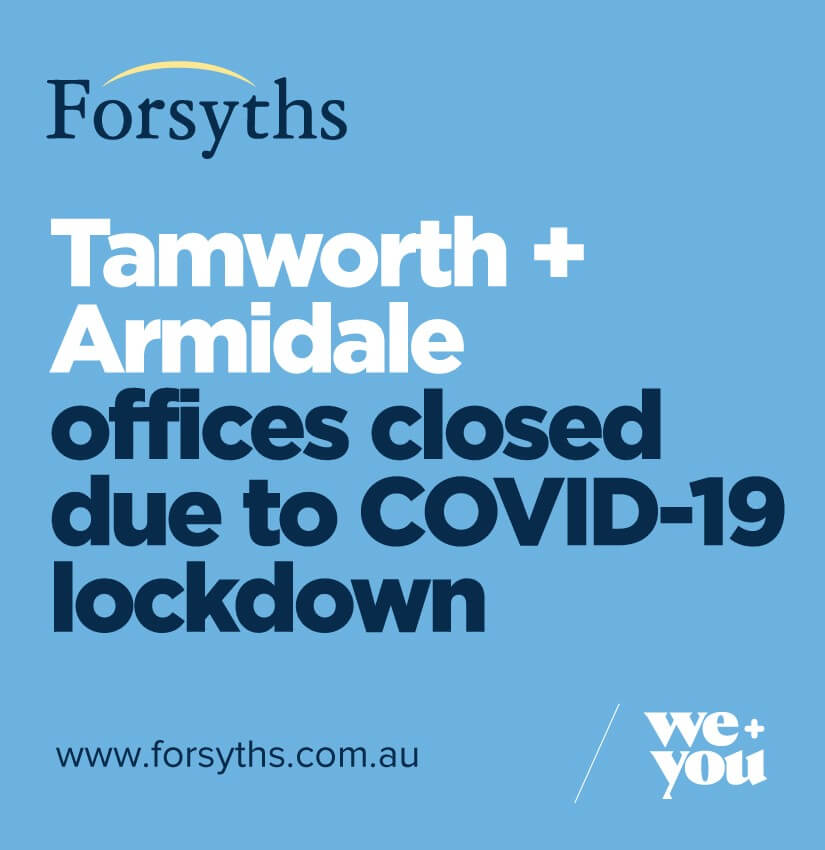
Forsyths Office Arrangements during COVID-19 lockdown.
Forsyths Office Arrangements during COVID-19 lockdown. Due to the recent lockdown announcements, the Tamworth and Armidale Forsyths offices will be closed to clients for the next 7 days.

Lockdown Support - New Measures Announced
The NSW and Federal Governments have announced a series of new measures to support business during extended lockdowns of four weeks or more:

Where do reward programs stand in regard to tax?
Many businesses and organisations offer their customers loyalty award-based incentive programs. They are designed to reward customers for purchasing or using a company’s goods and services (or sometimes affiliated businesses).

Trust distributions from a discretionary trust
The purpose of a trust is to separate the legal and beneficial ownership of assets. The legal ownership of the asset rests with the trustee. The beneficiaries benefit from the income that flows from the assets.

Trust losses: Keeping them in the family
Who can (and can’t) be part a family group for the purpose of making a family trust election (FTE)?

Capital works deductions for rental property
Rental property investors can claim capital works deductions for construction costs for a rental property, however there are limits imposed in relation to the dates such works were completed.

What the new - your future, your super means for you
Recent legislative reforms to the superannuation arena are set to change the retirement savings landscape for many Australians.

What lockdown support is available to business?
The NSW and Federal Governments have announced a series of new measures to support business during extended lockdowns of four weeks or more.

Avoid common mistakes in your business return, and include appropriate income
We know you want to get your tax right, so it may help you this tax time to know how to avoid making what the ATO has found are the most common tax mistakes.

Getting deductions for clothing and laundry expenses right
The ATO allows certain taxpayers to claim a deduction for the cost of buying and cleaning occupation-specific clothing, items of protective wear and for certain unique, and usually distinctive, uniforms.

Steps to take when winding up your SMSF
There will most likely come a time when your SMSF will need to be wound up, with a change in members, the fund’s finances, perhaps separation or other family causes among the many reasons why winding up the fund becomes necessary.

When the taxman sends a bill, not a refund
Most people who earn income as employees have tax payments made on their behalf throughout the year through pay-as-you-go (PAYG) withholding to help them meet their annual tax obligations. But this withholding of amounts can sometimes miss the mark.

Super Guarantee rate increase on 1 July 2021
As of 1 July 2021, the minimum super guarantee rate will rise from 9.5% to 10%, with further increases over the next five years.

The ATO’s eligibility requirements for SMSF trustees or directors
All members of a self-managed super fund (SMSF) must be individual trustees or directors of the fund’s corporate trustee. Anyone 18 years old or over can be a trustee or director of a super fund as long as they’re not under a legal disability (such as mental incapacity) or a disqualified person.

New guidance on “personal services income” rules
The ATO has recently updated its guidance material on the operation of the personal services income (PSI) and personal service business (PSB) rules.

The tax treatment of cryptocurrency
Cryptocurrencies, once again surging in popularity, have a unique tax treatment that every taxpayer dealing with cryptocurrency should be aware of.

Federal Budget 2021-22
The Government has decided not to go down the austerity path, which will be a relief for many taxpayers and businesses.

Evidencing SMSF property valuations
The ATO recently clarified the evidence that is required to support real property valuations within SMSFs, particularly in light of the unique challenges brought about by COVID-19.

The SME Recovery Loan Scheme is now open
Loans for small to medium enterprises (SMEs) are available until 31 December 2021 under the Federal Government’s SME Recovery Loan Scheme. The scheme is designed to support the economic recovery, and to provide continued assistance, to firms that received JobKeeper and also to businesses that are flood-affected.

Dealing with excess before-tax super contributions
Making extra before-tax contributions into super (called concessional contributions) can help boost a person’s retirement savings. But fund members need to be aware of the implications for when they exceed the concessional contributions cap.

EOFY tips for your tax plan
The financial year is almost over, but there are still effective strategies you may be able to put in place.The aim is to make sure you pay no more tax than you have to for the 2020-21 year and maximise any refunds you may be entitled to. This is still the case, if not more so, in the on-going COVID-19 environment.

Some payments are not counted as income by the ATO
It is possible to receive certain payments that do not need to be included as income in your tax return. However some of these amounts may be used in other calculations, and may therefore need to be included elsewhere in your tax return.

Refinancing loan interest may be deductible to a partnership
A general law partnership is formed when two or more people (and up to, but no more than, 20 people) go into business together. Partnerships are generally set up so that all partners are equally responsible for the management of the business, but each also has liability for the debts that business may incur.

Managing your superannuation transfer balance account
Most people think of retirement as a time to put your feet up and relax, but it can also be a time when pre-retirees and retirees alike actually need to flex the grey matter.

When it comes to real estate and CGT, look at timing
When you sell or otherwise dispose of real estate, the time of the event (when you make a capital gain or loss) is usually when one of the following occurs:

New insolvency reforms to support small business
The Australian Government has made changes to the ATO’s insolvency framework to help more small businesses restructure and survive the economic impact of COVID-19.

APRA annual report on superannuation
The latest annual statistical report from APRA has been released, covering the 2020 income year but only made public at the end of January 2021.

New Director Identification Number regime may be just around the corner.
The Director Identification Number (DIN) regime may have been lost in many business owners’ peripheral vision, or even dropped off the radar completely, as it has been on the horizon for some time.

Used goods for private use? Here's the latest values.
This common practice can occur in businesses such as butchers, bakers, corner stores, cafes and more.

Unexpected lump sum payment in arrears? There’s a tax offset for that!
A lump sum payment in arrears is a payment you may receive that relates to earlier income years.

A hand up for small businesses on cash flow.
The ATO has produced a “Cash Flow Coaching Kit”, which is a free resource and designed as a value-add advisory tool for small business owners.

Vehicle benefit FBT treatment changes under COVID-19.
The special circumstances that coronavirus has thrown our way looks like having some very practical outcomes on certain areas of fringe benefits tax.

Update your ABN ... or miss out!
Government agencies regularly access data contained in the ABN registration, and where this is not up-to-date the taxpayer may be missing out on stimulus measures, grants, and other government support.

Natural disasters and help with your tax
Now that we are into bushfire season, and with flooding events having already occurred, it is perhaps timely to be reminded that as well as the more obvious immediate devastation inflicted on people’s property.

Getting a tax valuation from the ATO
Not every individual situation fits neatly with the tax laws as they stand — sometimes a taxable item’s known value (and therefore the tax that applies to it) may need to be determined.

Single touch payroll: When your reporting can cease
A business may no longer be required to lodge single touch payroll (STP) reports for a number of reasons.

JobMaker hiring credit: What you need to know
The JobMaker Hiring Credit scheme was passed into law in mid-November 2020.

What is a recipient created tax invoice?
Tax invoices are an essential element of Australia’s taxation system

Claiming interest expenses for rental properties
Interest is a common deduction claimed by taxpayers.


Calling time out on your business?
Calling time out on your business? Some essentials you’ll need to know

A run-down of the new loss carry back measure
The last Federal Budget carried with it a number of tax changes.

JobKeeper extension’s alternative turnover tests
The extension of the JobKeeper scheme is now based on current GST turnover, not projected turnover. The basic test compares year-on year turnover. If there were events or circumstances outside the usual business settings that resulted in your relevant comparison period in 2019 (September or December 2019 quarter) not being appropriate, then an alternative test may apply.

Rounding of GST where fractions of a cent result
The ATO has devised special rounding conventions where an amount of GST includes a fraction of a cent. Although it labels these conventions “rules”

Contact

Social

Offices